
Vitamin K2 Benefits: What's Real and What's Hype
Updated
The short answer
Vitamin K2 switches on two proteins that do impressive work. One helps lock calcium into your bones. The other helps keep calcium out of your arteries.
That biology is solid. What's much less clear is whether taking a K2 supplement changes anything you can measure, such as bone density, fractures or artery health.
If you've read that K2 prevents osteoporosis or cleans out your arteries, there's a good chance you were reading marketing rather than evidence.
At BULT, we know that more of a nutrient doesn't automatically mean more benefit. Below, we lay out what the K2 research actually shows, so you can decide whether a K2 supplement makes sense for you.
In this guide
- K1 and K2 aren't the same vitamin
- MK-4 vs. MK-7
- What K2 actually does
- Does vitamin K2 support bone health?
- Does vitamin K2 support artery health?
- Do you have to take K2 with vitamin D?
- How much vitamin K do men need?
- Is vitamin K2 safe?
- So, should men take vitamin K2?
- Where BULT comes in
- Common questions about vitamin K2
K1 and K2 aren't the same vitamin
Start researching vitamin K and you'll quickly find there's more than one type. Knowing the difference, and what the case for supplementing actually is, is the key to deciding whether it's right for you.
Vitamin K1
Phylloquinone
Comes from plants, mostly leafy greens. It makes up about 90% of the vitamin K in a typical Western diet. A cup of boiled kale has about 493 mcg.
Vitamin K2
Menaquinones
A different family of compounds, mostly made by bacteria and found in fermented and animal foods. The versions you'll see on supplement labels are MK-4 and MK-7.
The richest K2 food on earth is natto, a Japanese fermented soybean dish, at 998 mcg of MK-7 per 100 g. Almost nobody outside Japan eats it. In a Western diet, cheese is your realistic source. When researchers measured the K2 content of cheese, Münster came in around 80 mcg per 100 g, Gouda about 65 and cheddar about 23. Parmesan had almost none.
| Food | Vitamin K2 per 100 g |
|---|---|
| Natto | ~998 mcg |
| Münster cheese | ~80 mcg |
| Gouda | ~65 mcg |
| Cheddar | ~23 mcg |
| Parmesan | ~0 mcg |
Sources: Linus Pauling Institute; Vermeer et al., Nutrients, 2018.
Most men aren't getting much. Studies of Dutch and German men have estimated average K2 intake at roughly 31 and 35 mcg a day. In Western diets, K1 makes up about 90% of total vitamin K intake, leaving K2 at roughly 10%.
Vitamin K2: MK-4 vs. MK-7
The difference between these two forms comes down to staying power. According to a review of vitamin K kinetics, MK-4 is essentially gone from your blood within 24 hours, while MK-7 has a half-life of about three days. That's why supplements typically use MK-7: one daily dose actually maintains a steady level.
Fair warning, though: lasting longer in your blood isn't the same as working better. No study has put MK-7 head to head against MK-4 and shown better health outcomes.
What K2 actually does
Some proteins in your body can't grip calcium until vitamin K modifies them. Think of it as flipping a switch: before the switch, the protein exists but does nothing.
Two of these proteins are why people care about K2:
Osteocalcin
Helps build calcium into the mineral structure of bone.
Matrix Gla protein
Does the opposite job in your blood vessels. It's been described as the most powerful natural inhibitor of calcification in the human body.
Without enough vitamin K, your body still makes both proteins. They just sit there switched off.
So the theory writes itself: take K2, flip the switches, get stronger bones and cleaner arteries.
The switch-flipping part happens reliably. Turning that into stronger bones and cleaner arteries is where the evidence starts to break down.
Does vitamin K2 support bone health?
This is the part that surprises most people.
One of the largest K2 bone trials ever run came up mostly empty. It followed 4,378 Japanese women with osteoporosis who took calcium, with or without high-dose MK-4. After three years, there was no significant difference in new spinal fractures between the groups, and no significant difference in other fractures at four years. The only signal was in a subgroup of women who already had five or more spinal fractures.
About those Japanese studies you'll see cited everywhere
They used 45 mg a day of MK-4. That's roughly 150 to 180 times the recommended daily intake of vitamin K, and it's a prescription drug dose in Japan, not a supplement dose. Those results can't be stretched to cover a 100–200 mcg capsule. The gap is several hundredfold.
Broader reviews land in a similar place. The most comprehensive pooled analysis, covering 36 vitamin K trials, concluded "there is no evidence that vitamin K affects bone mineral density or vertebral fractures." It did find a possible reduction in clinical fractures, but that result lost statistical significance when only the lowest-risk-of-bias trials were included. The authors' verdict: vitamin K "may reduce clinical fractures," but "the evidence is insufficient to confirm this."
Does vitamin K2 support artery health?
Nearly all the excitement about K2 and heart health traces back to a single study.
The Rotterdam Study followed 4,807 Dutch adults for up to a decade. People eating the most K2 had a 57% lower risk of dying from heart disease and about half the odds of severe aortic calcification, compared with those eating the least. K1 showed no association at all.
−57%
heart disease deaths, highest vs. lowest K2 intake
−52%
odds of severe aortic calcification
But…
observational only. Nothing was tested.
Those numbers are eye-catching. They're also observational: the study watched what people ate, it didn't test anything. In that group, K2 came mostly from cheese and meat, which tangles it up with an entire diet and lifestyle. The Linus Pauling Institute puts it bluntly: vitamin K2 "may solely be a marker of a heart-healthy diet and might not itself be cardioprotective."
When researchers tested K2 directly in men, it didn't deliver. In a two-year trial, 365 Danish men aged 65 to 74 took 720 mcg of vitamin K2 plus 25 mcg of vitamin D daily. It didn't slow calcification in the aortic valve, the trial's main target. (There was a possible slowing of coronary artery calcium that the researchers said needs more study.)
A 2023 review of 14 trials found a statistically significant but modest effect on coronary artery calcium, based on just four studies. Of the eight studies that looked at other arteries and valves, six found no significant effect.
"You have to take K2 with vitamin D." Is that true?
You'll see this everywhere. The logic is real, but the evidence is thin.
The logic: vitamin D raises calcium absorption and tells your body to make more of those calcium-handling proteins. Vitamin K is what switches them on. More D without enough K means more switched-off proteins. That much is legitimate biochemistry.
The evidence: that same review says flat out "there is not enough evidence to recommend combined vitamin D and K supplementation" for bone health, and that on the heart side "very few clinical studies have been conducted." A 2026 randomized trial analysis tested whether people's vitamin K status changed what vitamin D did for their bone and heart markers, and found no interaction. It was a short, eight-week study, so it isn't the final word, but it doesn't support the "you must pair them" rule either.
How much vitamin K do men need?
The adequate intake for men is 120 mcg a day. But there are two things to keep in mind about that number.
First, it was set in 2001 based on K1 alone. Per the Linus Pauling Institute, the Food and Nutrition Board "did not consider menaquinone intakes." There's no official recommended amount for K2 specifically. If you see one, it probably came off a product label.
Second, falling below that target isn't the same as being deficient. Clinically significant vitamin K deficiency in adults is, per the NIH, "very rare," and mostly limited to people with absorption disorders or on certain medications. (It isn't on our list of the most common nutrient deficiencies in men for that reason.)
So no, supplementing with K2 isn't fixing a widespread deficiency. But vitamin K is a foundational nutrient your body needs for key functions. That's a good argument for getting a reasonable amount and not thinking about it again. It's not an argument for buying a $40 bottle of K2.
Is vitamin K2 safe?
For most people, vitamin K is about as safe as vitamins get. No upper limit has been set, and according to the NIH, no adverse effects from vitamin K in food or supplements have been reported in humans or animals.
There's one big exception, and it's serious.
⚠ If you take warfarin (Coumadin) or a similar blood thinner
Vitamin K works directly against these drugs. The NIH calls this "a serious and potentially dangerous interaction."
The amounts involved are startlingly small. In a controlled study of volunteers on a warfarin-type drug, MK-7 at just 10 mcg a day caused a clinically relevant change in at least 40% of subjects, and 20 mcg a day in at least 60%. The researchers concluded that MK-7 supplements "need to be avoided" by people on these drugs.
Typical K2 supplements contain 100 to 200 mcg, five to twenty times the amounts that caused problems. Don't take any vitamin K supplement, including a multivitamin that contains it, without talking to your doctor first.
So, should men take vitamin K2?
The biology is real and interesting, but many supplement claims are ahead of the evidence. Bone outcomes mostly haven't followed in trials outside those high-dose Japanese studies. The heart health case rests on one observational study, and the trial that tested K2 in men came back negative on its main outcome.
Food is a perfectly reasonable route: cheese, natto if you're adventurous, and other animal foods for K2, plus leafy greens for K1. Actual deficiency is rare.
If you're building a solid foundation of daily nutrition, a multivitamin that includes a sensible dose of K2 can be a reasonable addition. A standalone K2 bottle is a much harder case to make. (For more on that, see whether supplement stacks actually work.)
Where BULT comes in
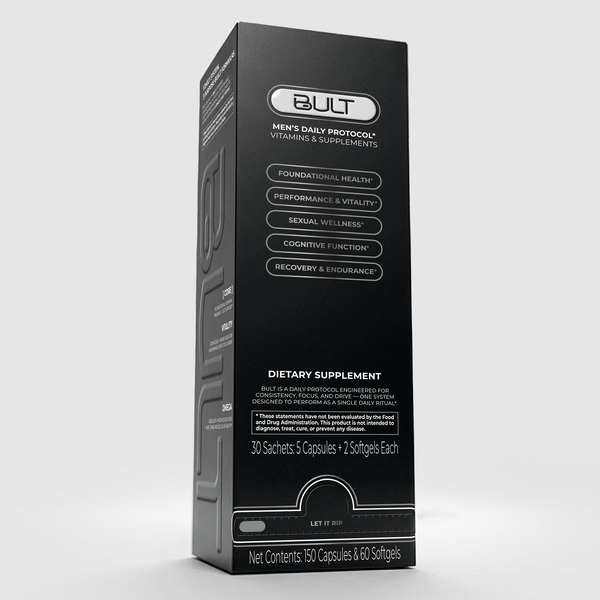
BULT's CORE capsules contain 120 mcg of vitamin K2 as MK-7. So why is it there? Because the case for a foundational men's daily vitamin pack is the opposite of the case for a single-ingredient supplement.
A standalone K2 bottle only makes sense if K2 specifically is going to do something dramatic for you, and as you've just read, nobody can promise that. A complete formula doesn't need that bet to pay off. It needs the essential nutrients covered at sensible doses, chosen for sound biology and good safety, so you're not depending on any one of them to be a hero.
K2 clears that bar. The mechanism is real. The safety profile is clean for anyone not on a blood thinner. And most Western diets supply only around 30 mcg a day, so there's room to add some.
We won't sell you K2 on a promise the research doesn't support. If a trial lands that settles this question in either direction, we'll say so, including if it settles against us.
That's the whole point of this post. It's how we think about every ingredient in the pack, and it's why the full panel is published on the science behind BULT rather than hidden behind a proprietary blend.
Common questions about vitamin K2
What does vitamin K2 do?
K2 switches on proteins that handle calcium: osteocalcin, which helps build calcium into bone, and matrix Gla protein, which helps keep calcium out of arteries. Without enough vitamin K, those proteins get made but stay inactive.
Is K2 better than K1?
They're not interchangeable. K1 is the main dietary form and is mostly used by the liver for blood clotting. K2 stays in your blood longer and travels more readily to tissues outside the liver. There's no separate official recommendation for K2, and no head-to-head trial has shown K2 supplements beat K1 for bone outcomes.
Do I need to take K2 with vitamin D?
The reasoning is sound: vitamin D increases production of proteins that vitamin K has to activate. But the leading review says there isn't enough evidence to recommend taking them together, and a 2026 trial analysis found vitamin K status didn't change what vitamin D did. No human trial has shown that vitamin D taken without K2 calcifies your arteries.
MK-4 or MK-7?
MK-7 has a half-life of about three days; MK-4 is essentially gone within a day. That's why most supplements use MK-7. No head-to-head trial has shown either produces better health outcomes.
Does K2 boost testosterone?
There's no human evidence for this. The claim traces back to a 2011 study in rats and lab-grown cells using MK-4. Don't assume it applies to you.
Can I take K2 on a blood thinner?
Not without talking to your doctor. In a controlled study, MK-7 at as little as 10–20 mcg a day disrupted anticoagulation in many subjects, and typical supplements contain 5 to 20 times that.
What foods have K2?
Natto is by far the richest at about 998 mcg per 100 g. In Western diets, the main source is cheese: Münster has about 80 mcg per 100 g, Gouda about 65 and cheddar about 23. Typical Western intake is around 30 mcg a day.
*These statements have not been evaluated by the Food and Drug Administration. This product is not intended to diagnose, treat, cure, or prevent any disease.
This article is general education, not medical advice. If you take a blood thinner or have a medical condition, talk to a healthcare professional before starting any supplement.