
Does B12 Give You Energy? The Honest Answer
Updated
The short answer
If your B12 is already fine, more B12 won't make you less tired. The National Institutes of Health says it outright: B12 supplementation "appears to have no beneficial effect on performance in the absence of a nutritional deficit."
If you're actually low, that's a different story. Fatigue is a real symptom of B12 deficiency, and correcting a true deficiency can help.
So the real question isn't "Does B12 give me energy?" It's "Am I actually low?" For most men, the answer is no.
So why are so many supplement brands selling megadoses of B12? Below, we walk through what the research says about B12 and energy: how it works, where it doesn't, and how to tell hype from help.
In this guide
Why everyone's selling you B12
In 2024, 71.5% of American adults said they'd felt very tired or exhausted at least some days in the past three months. About 13% of men said it was most days or every day.
That's a lot of tired people, and B12 is the easiest thing to sell them: energy shots, B12 shots, checkout-counter tablets with 5,000% of your daily value on the label.
Unfortunately, almost none of that marketing lines up with the research.
In the same CDC data, frequent fatigue was most common in the youngest adults (19.5% of 18- to 34-year-olds) and dropped steadily with age. B12 deficiency does the opposite: it gets more common as you get older. If low B12 were really why everyone's dragging, the numbers would run the other way.
19.5%
of adults 18–34 report frequent fatigue
12.9%
of adults 65+ report frequent fatigue
↑ with age
B12 deficiency risk, the opposite pattern
Source: CDC/NCHS, National Health Interview Survey 2024. "Frequent" = most days or every day.
What B12 actually does
None of this means B12 has nothing to do with energy. B12 has two jobs in your body. Both are real, and one connects directly to energy.
B12 helps convert a compound called methylmalonyl-CoA into succinyl-CoA, which feeds into the cycle your cells use to make ATP, the actual currency of cellular energy. Put simply, B12 is a key part of the process your cells use to power their work.
Here's the part the marketing skips: vitamins don't contain any energy. They have zero calories. What they do, as one review of the evidence puts it, is "make possible the extraction of energy" from the food that actually has calories.
B12 is the wrench, not the fuel. If the bolt's already tight (because you already have plenty of B12), a second wrench doesn't help.
What happens when non-deficient people take B12
Researchers have tested B12 in people who aren't clearly deficient, though mostly for brain and mood, not energy. A 2021 review of 16 randomized trials, mostly in older adults whose average B12 levels weren't in the deficient range, concluded that supplementation is "likely ineffective" for cognitive function and depressive symptoms. Only one of those trials measured fatigue at all.
That gap tells you something: for all the "B12 for energy" marketing, there's very little evidence behind it in people with normal levels.
Mayo Clinic is blunt about it: "There's no proof that taking vitamin B-12 supplements or injections boosts energy or improves athletic performance." Harvard Health agrees, noting that B12 shots "probably won't increase your energy unless you are B12-deficient."
So is there a real case for B12 supplements? There can be, for the right person, at the right dose. (For the nutrients that do have a stronger link to energy, see our guide to the best vitamins for energy in men.)
When B12 actually helps
About 3.6% of American adults are deficient in B12, and another 12.5% are borderline.
Symptoms include fatigue, heart palpitations, pale skin, weight loss, and numbness or tingling in your hands and feet. One thing worth knowing: nerve symptoms can show up without anemia, so a normal blood count doesn't rule out a deficiency.
You're more likely to be low if you:
- Are over 50. Stomach acid drops with age, and you need it to release B12 from food. (More on what changes in our guide to the best multivitamin for men over 40.)
- Don't eat animal products. B12 occurs naturally almost only in animal foods, so vegans are at highest risk.
- Take metformin. Among adults with diabetes, deficiency ran 5.8% in metformin users vs. 2.4% in non-users, nearly three times the odds after adjustment.
- Take acid reducers long-term. Omeprazole and similar drugs interfere with pulling B12 out of food.
Now the part that probably applies to you: only 5% of American men get less B12 from food than they need. If you eat meat, eggs or dairy and you're under 50, B12 deficiency is very unlikely to be why you're tired. (For the shortfalls that are more common in men, see the most common nutrient deficiencies in men.)
If you're wiped out all the time, get a blood test. It's inexpensive, it's clear, and it beats guessing: deficiency shows up in bloodwork.
How much B12 do men actually need?
Knowing how B12 works, you're probably wondering whether supplementing is even worth it. The answer depends on the supplement, and on why you're taking it.
The daily value for B12 is 2.4 micrograms. That's it.
So a 1,000 mcg tablet is 41,667% of your daily value. A 5,000 mcg lozenge is over 208,000%. Those numbers look impressive, but mostly they measure how much your body is about to ignore.
Absorbing B12 depends on intrinsic factor, a protein your stomach makes, and that system maxes out fast, at about 1 to 2 micrograms per dose. Past that, absorption falls off a cliff. Per the NIH, you absorb only about 2% of a 500 mcg dose and 1.3% of a 1,000 mcg dose.
Do the math on a 1,000 mcg tablet
| On the label | 1,000 mcg (41,667% DV) |
| Absorbed (~1.3%) | ~13 mcg |
| Never makes it in | ~987 mcg |
Big B12 numbers aren't a sign of a better supplement. They're a marketing decision. Once you know that, the number on the front of the bottle stops being useful, and the better question becomes who set the dose, and why.
Methylcobalamin vs. cyanocobalamin
You'll see methylcobalamin sold as the superior "bioactive" form of B12. The evidence doesn't back that up.
The NIH is direct about it: "No evidence indicates that absorption rates of vitamin B12 in supplements vary by form of the vitamin." A peer-reviewed analysis reached the same conclusion: the forms all end up in the same place inside your cells.
| Methylcobalamin | Cyanocobalamin | |
|---|---|---|
| Found naturally in food | Yes | No (synthetic) |
| Proven better absorption | No | No |
| Releases a trace cyanide molecule | No | Yes (harmless at supplement doses) |
There are still reasonable reasons to prefer methylcobalamin. It's one of the forms found naturally in food, and cyanocobalamin releases a trace cyanide molecule when your body converts it. That's harmless at these doses, but some formulators would rather skip it. (It's the same thinking behind using methylated folate. See why methylated folate matters.)
Is high-dose B12 dangerous?
Not really. The NIH hasn't set an upper limit for B12 because of its low potential for toxicity, and a big part of why megadoses are harmless is that you never absorb most of them.
One honest caveat: Mayo Clinic notes that B12 levels that are too high may be linked to a higher risk of cancer or hip fracture. Researchers are still working out whether high B12 causes problems or mostly signals something else going on. Either way, more isn't automatically better.
What to do if you're tired
- 1Test before you treat. B12 is one of many possible causes of fatigue, and it's one of the easiest to check.
- 2Know if you're in a risk group. Over 50, plant-based, on metformin, or on long-term acid reducers.
- 3Ignore the dose on the label. Absorption caps out regardless.
- 4Fix sleep first. No pill outruns five hours a night.
- 5Cover the basics and stop chasing single nutrients. The useful version of a supplement isn't a megadose of whatever you read about this week. It's adequate amounts of the essential nutrients for men, taken consistently, so you can rule them out and move on to what's actually making you tired. (Not sure how much is too much? See how many supplements a man should take daily and explore the best time to take vitamins.)
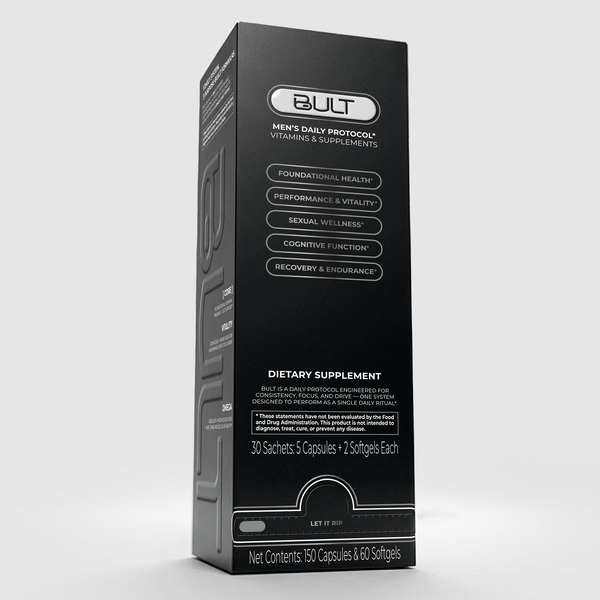
BULT and B12
Awkward moment: BULT contains B12. We just spent more than a thousand words explaining why B12 probably isn't what's making you tired. That's exactly why we built the product the way we did.
The case for a men's daily vitamin pack was never that one ingredient will change your life. It's that the foundational nutrients, the vitamins and minerals that actually have requirements attached, should be covered at sensible doses, in published amounts, without you spending an evening reading NIH fact sheets to figure out whether you're being sold a number or a solution.
BULT's CORE capsules contain 25 mcg of B12 as methylcobalamin. Not 5,000. Not 1,000. Twenty-five: roughly ten times the daily value, which is enough to cover you comfortably without pretending a bigger number on the label means a better supplement. You already know why a 5,000 mcg dose would be theater.
We use methylcobalamin because we prefer it, and because it's one of the forms that occur naturally in food.
And we're not going to sell you B12 as a miracle cure for fatigue. What we will do is tell you when a nutrient isn't a magic solution, publish every dose, and size those doses to the biology instead of the marketing. You can see every ingredient and amount on the science behind BULT.
Common questions about B12 for men
Does B12 give you energy?
Not if your levels are already adequate. B12 is required for reactions that release energy from food, but taking more than you need doesn't produce more energy. The NIH states that B12 supplementation appears to have no beneficial effect on performance without a nutritional deficit.
How fast does B12 work if I'm deficient?
It depends on the cause and how low you are, so ask your doctor. For context, your body stores about 1 to 5 mg of B12, roughly 1,000 to 2,000 times what you typically take in from food in a day. That's why a deficiency can take years to show up.
Is methylcobalamin better than cyanocobalamin?
According to the NIH, no evidence shows absorption differs between forms of B12 in supplements. Preferring methylcobalamin is reasonable for other reasons, but it hasn't been shown to absorb better.
Can you take too much B12?
No upper limit has been set, because the risk of toxicity is low and most of a big dose never gets absorbed. That said, Mayo Clinic notes that B12 levels that are too high may be linked to a higher risk of cancer or hip fracture, so more isn't automatically better.
Why do B12 labels show percentages like 41,667%?
Because the daily value is only 2.4 mcg. Absorption maxes out at about 1–2 mcg per dose, so you take in roughly 1.3% of a 1,000 mcg tablet. The percentage describes the label, not what reaches your cells.
Who's most likely to be low on B12?
Adults over 50, vegans and vegetarians, people taking metformin, people on long-term acid reducers, and anyone with an absorption disorder such as pernicious anemia.
*These statements have not been evaluated by the Food and Drug Administration. This product is not intended to diagnose, treat, cure, or prevent any disease.
This article is general education, not medical advice. If you're persistently fatigued, talk to a healthcare professional instead of self-treating.